Residents’ Assembly
The Residents’ Assembly (RA) is a statutory body established under Section 18 of the Auroville Foundation Act, 1988. It includes all adult residents of Auroville, giving them the collective responsibility to experiment with and evolve their own conventions of decision-making. However, Section 19 of the same Act leaves the operational mechanisms of the RA undefined; an intentional gap that underscores the residents’ ’utter freedom’ and Auroville’s character as an ‘experimental township’. For a better understanding of the RA, here we turn to Kireet Joshi’s reflections on the theoretical foundations of the Act.1 As the principal figure involved in drafting the Act, his interpretation offers a grounding perspective on how the RA is meant to function. Returning to these original insights helps anchor today’s discussions and guard against the drift of self-serving interpretations.
- System of the RA: Democratic Democracy
In shaping a system for the RA, reference was made to Aurobindo’s concept of democratic democracy as contrasted to parliamentary democracy. Unlike parliamentary systems, which operate through representatives and, as Joshi put it, often devolve into the “rule of a few rich and wicked people”, this model was meant to avoid sidelining individuals. The forum envisioned for Auroville is to be a “Residents’ Assembly, not a Representatives’ Assembly”!
“We have to arrive at that point where each individual resident is awake, he is alive and he is very keen, as Sri Aurobindo says, to perfect himself and to aid and to be aided by others’ perfection. This is the stage where we should reach. And the Residents’ Assembly is an instrument for springing into this. As long as individuals are simply put aside or simply taken up sometimes for getting their opinion, it is a mask and it is very inadequate and very, very unsatisfactory form of service to the divine consciousness.”
- Internal Dynamics of the RA: Divine Anarchy
Joshi understood the Act as being designed to give shape to Mother’s idea of divine anarchy. But what exactly does this mean, and how does it differ from other forms of governance? Unlike monarchy, oligarchy, or even conventional forms of democracy, divine anarchy implies the absence of rules imposed from outside. Instead, it rests on the principle that only the Divine guides the individuals of the RA; a ruling force arising from within rather than being enforced from without. This inner guidance acknowledges diversity, and it is through unity in that diversity that divine anarchy is ultimately realized.
In this sense, the Act seeks to secure an ‘utter freedom’ for the RA, ensuring that
“the individuals constituting the totality have the freedom to grow […] and if any attempt is made to curb this freedom, then there is a provision in the Act itself of an authority whose very duty is to advise the Governing Board in such a way that this freedom is not curbed”.2
- RA in the Intra-institutional Context
As already mentioned, the AVF Act does not prescribe any fixed form of governance for the RA;
“[…] Sometimes some people reading from outside may feel it is a lacuna in the Act, that no form is given for the Residents’ Assembly. But from another point of view, it is a safeguard against imposition of any form. So, you might say that there is an utter freedom given to the Residents’ Assembly to experiment, to make research and to devise forms by which the divine anarchy can be realised. If the residents of Auroville know how to do it, if they ripen themselves into that consciousness, this freedom is ensured in the Act. In the meantime, there is also a provision in the Auroville Act that although there is a Governing Board which may from outside seem to be a board which would control, superintend, supervise, intervene, supervene and you might say it is a final authority, this Governing Board is required to consult the Residents’ Assembly according to this Act itself, and there are provisions in the functions of the Residents’ Assembly where it is laid down that Residents’ Assembly will organise all the activities of Auroville, so the scope is widest. There is not a single activity which Residents’ Assembly cannot organise. As a result, I find that Mother’s intention that Auroville will be a field of research and particularly the concept of divine anarchy, if the residents of Auroville decide to conceive of the forms, of this form of development and organisation, it would be perfectly possible to do so within the framework of this entire Act.”
As seen from the discussion above, the Act establishes no final authority in Auroville’s governance; each of the three bodies (GB, RA, and IAC) is meant to function in relation to the others, with mutual advice rather than hierarchy. The smooth working of this system depends on a crucial precondition: a high level of consciousness among all participants; including members of the Governing Board. Joshi, drawing on both Kant and Aurobindo, contributed to this vision at a philosophical level. Yet in practical terms, the Act leaves it to the residents themselves to experiment with workable solutions for achieving unity in diversity. In 1999, Joshi proposed creation of a Unity Committee, intended to strengthen the forces of cohesion during moments of debate and division. While this idea was never implemented, the question of how the Act’s spiritually inspired framework can function in practice, especially as the community grows, remains a pressing challenge.
- Structure of the RA
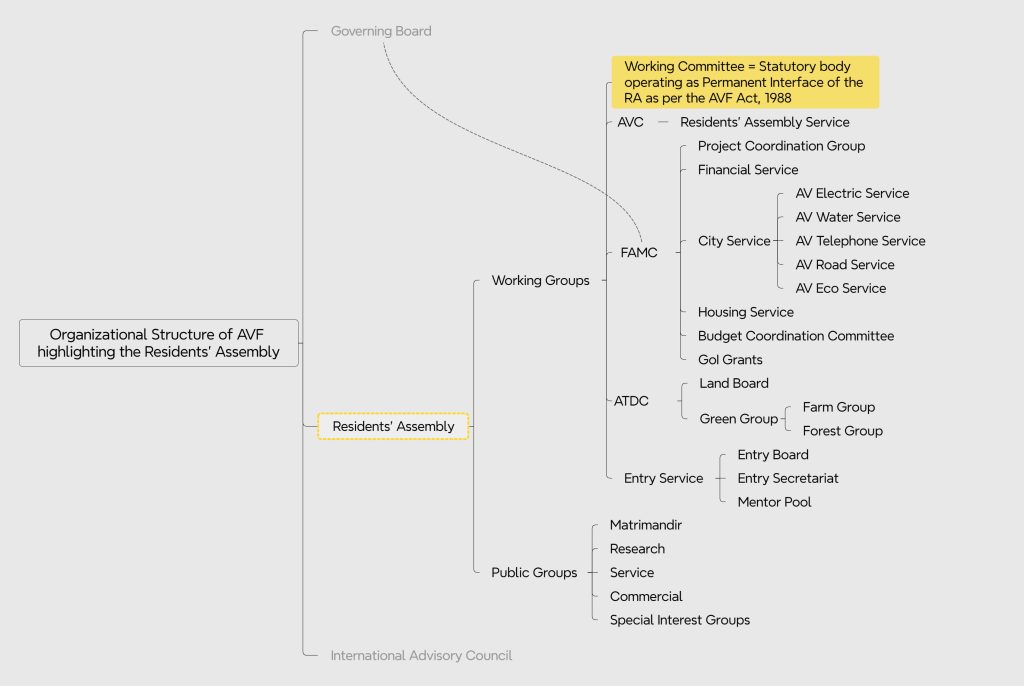
Over the past decades, the functions and activities of the Residents’ Assembly have evolved significantly. The diagram below outlines the current organizational structure (as of December 2025), distinguishing between two main levels: Working Groups and Public Groups. In Auroville’s terminology, Working Groups refers to the five key committees and councils of the Residents’ Assembly that hold decision-making authority. Importantly, in keeping with the Act,members of the Working Groups are to be appointed directly by the RA itself.
- The Working Committee serves as the permanent interface of the RA as envisaged under Section 20 of the AVF Act, 1988. Its members are chosen by the RA from among its residents, and its role is to assist both the RA and the GB. Since 2022 Auroville has been operating with two parallel Working Committees; one elected by the RA (known as RA WCom) in accordance with the Act, and another appointed by the GB in contradiction to the Act.
- The Auroville Council, constituted under section 19 of the AVF Act and established in 1993, is tasked with assisting the RA in organizing its activities. Its responsibilities include maintaining and harmonizing the various mandates of Auroville’s Working Groups, as well as monitoring their functions.
- The Funds and Assets Management Committee was established in 1996 at the request of the Governing Board to the Working Committee of the RA. Its mandate pertains to overseeing the use of funds, managing assets, handling taxes and audits, addressing matters related to trusts and units under the Foundation, recommending the sale or exchange of land, and managing both movable and immovable properties.
- The L’avenir d’Auroville / Auroville Town Development Council was established in 2007 as an umbrella body uniting all the active planning groups at the time, with the aim of enhancing the planning, development, and construction of the Auroville township. Until 2011, it operated under the name L’avenir d’Auroville, after which it was renamed L’avenir d’Auroville/ATDC under the Standing Order No. 6/2011. From 2007 to 2011, ATDC was operating under the mandates approved by the RA. In 2011, the GB prepared a new mandate and led the ATDC to operate under parallel mandates prepared separately by the RA and GB from 2011 to 2021. In 2021, the GB undermined the RA-selected ATDC and issued a new standing order and office order appointing their preferred members and have since been imposing decisions on the RA without consulting them as mandated in the Act.
- The Entry Service, established under the Auroville Entry Policy of 2017, is responsible for registering and supporting all applicants seeking admission to Auroville. It is composed of three parts; the Entry Board, Entry Secretariat, and Mentor Pool whose collective mandate is to evaluate applications, provide guidance and information, oversee the newcomer period, and accompany applicants on their path toward becoming Aurovilians, including making visa recommendations for foreign nationals. In 2023, the GB introduced new entry regulations which, as of this date (December 2025), are still pending before the court.
- All takes and quotes here are from Joshi, K. On Auroville – On Internal Organisation of Auroville, 1999. ↩︎
- International Advisory Council (IAC) is the authority meant in this quote. ↩︎